The Chicago Defender Newspaper Research Project
This internship was exciting. I would compare it to traveling in a time machine to put an informational history puzzle together. We ordered microfilm of The Chicago Defender for 1929 and 1930 at the Thomas G. Carpenter Library located on campus at the University of North Florida. This was my first experience with a microfilm machine.
We entered headlines and authors from the front pages, editorials and letters to the editor into an excel spreadsheet and coded them according to Robert Abbott’s platform set up for the Defender along with some modern categories we created. We coded from Oct. 26, 1929, to Oct. 25, 1930. There was a lot going on in the world during this time. The Great Northern Migration, the Stock Market Crash, the Great Depression, slavery, segregation, lynching, civil rights and pull-man porters, just to name a few.
Dr. Thornton, Dr. Perkins and I coded 70 identical entries to compare through intercoder reliability. Next, Dr. Varma and I entered the data into SPSS to compare to see if we agreed or disagreed. We also entered 2,422 entries that were coded into SPSS to calculate the percentages of what the top issues were through qualitative analysis. It was a very interesting process to watch data transform into variables that can be statistically analyzed.
After Dr. Varma submitted her report to Dr. Thornton and Dr. Perkins, they built their writing from the findings. We held meetings, reviewed the writings and inserted quotes from letters to the editors to prove their importance in our history and how African-American’s were forced to live and the suffering they endured during those times.
I created a bibliography in APA Style alphabetizing the in-text citations for Dr. Thornton and Dr. Perkins to include with their writing. Originally, we thought the style was going to be Chicago Style. It was exciting to take on the task of exploring a new style, then we changed it to APA. If I had the opportunity to do this project again, I would. It is important that all races know our history. As a journalist and a team member we must continue to give a voice to the voiceless even if it comes from the grave.
This table represents a number of articles from each section and the percentage of the total. This table was used to explain the devastation in economics in the chapter that Dr. Thornton and Dr. Perkins wrote and can be viewed on page 8.
Table 2.
Frequencies—Sections
| Section | Number of articles | Percentage |
| Front Page | 1,479 | 60.9% |
| Letter to the Editor | 452 | 18.6% |
| Editorial | 439 | 18.1% |
| Cartoon | 59 | 2.4% |
Table 3.
The front page of The Chicago Defender delivered news about politics 60.5 percent of the time, while religion was 60 percent of the time. The editorial section reported on politics 21.6 percent of the time during October 1929 to October 1930, while religion was 18.1 percent of the time. The letters from the readers were about politics 13.5 percent of the time and 21 percent of the time they wrote to the Defender about religion. These tables represent how the information that was researched through microfilm was applied.
| Politics | Religion | |
| Front Page | 60.5% | 60% |
| Opinion Editorial | 21.6% | 18.1% |
| Letter to the Editor | 13.5% | 21.0% |
| Cartoon |
Here is one example of how Dr. Perkins and Dr. Thornton applied a letter to the editor in their writing which is completed in the required APA style, and below is a quote from the letter to the editor from The Chicago Defender:
“The inequitable treatment of black service families was reflected in 7 percent of the Defender’s editorials and 6 percent of letters to the editor. It was also reflected in the paper’s editorial cartoons. On April 5, for example, the Defender published an editorial cartoon entitled “Gold Star Turns to Brass,” which depicted a Gold Star mother, head hung low, left at the dock as a segregated ship ferried white families to France. In a letter to the editor on April 12, 1930, George F. Miller, a resident of New Brunswick, New Jersey responded:
If there has been anything in recent years to cause my blood to boil it is the report of the decision of the war department to send Gold Star Colored mothers to Europe in a Jim-Crow ship. It is an outrage to suffer such upon the mothers of those lying dead in France in the cause of making the world “safe for democracy.” In my opinion if any one of these boys could lift his voice from the grave he would entreat his mother to stay home, rather than view his grave under such humiliating circumstances. (p. 14).”
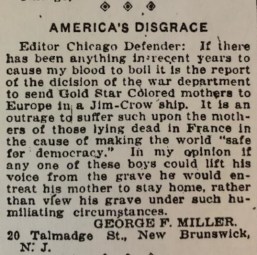
These are just a few of the examples that were used in the collection of data from the 52 week research sample in The Chicago Defender during the Great Northern Migration and the Great Depression. There is more research to be done on these letters and The Chicago Defender.
 Jennifer Graham